Category:OSWa6c6b673d314531e83bce1010db7a848: Difference between revisions
(add an example citation) |
mNo edit summary Tag: 2017 source edit |
||
| (15 intermediate revisions by 4 users not shown) | |||
| Line 1: | Line 1: | ||
Slurry mixing involves combining active materials, conductive additives, binders, and solvents to create a homogeneous electrode slurry mixture<ref>Ayerbe, et al. Adv. Energy Mater. 2022, 12, 2102696. DOI: {{Template:Viewer/Link|page=|url=https://doi.org/10.1002/aenm.202102696|label=10.1002/aenm.202102696}}</ref>. This slurry is then coated onto a current collector to form the electrode. Proper slurry mixing ensures optimal performance, consistency, and longevity of the batteries. | Slurry mixing involves combining active materials, conductive additives, binders, and solvents to create a homogeneous electrode slurry mixture<ref>Ayerbe, et al. Adv. Energy Mater. 2022, 12, 2102696. DOI: {{Template:Viewer/Link|page=|url=https://doi.org/10.1002/aenm.202102696|label=10.1002/aenm.202102696}}</ref> . This slurry is then coated onto a current collector to form the electrode. Proper slurry mixing ensures optimal performance, consistency, and longevity of the batteries. | ||
== Components of the Slurry == | == Components of the Slurry == | ||
# {{Template:Viewer/Link|page=|url=https://w3id.org/emmo/domain/electrochemistry#electrochemistry_79d1b273_58cd_4be6_a250_434817f7c261|label=Active Material}}: The main component responsible for electrochemical reactions. Examples include lithium cobalt oxide (LCO) | # {{Template:Viewer/Link|page=|url=https://w3id.org/emmo/domain/electrochemistry#electrochemistry_79d1b273_58cd_4be6_a250_434817f7c261|label=Active Material}}: The main component responsible for electrochemical reactions. Examples include lithium cobalt oxide (LCO) and graphite. | ||
# {{Template:Viewer/Link|page=|url=https://w3id.org/emmo/domain/electrochemistry#electrochemistry_82fef384_8eec_4765_b707_5397054df594|label=Conductive Additives}}: Materials like carbon black or carbon nanotubes that enhance electrical conductivity. | # {{Template:Viewer/Link|page=|url=https://w3id.org/emmo/domain/electrochemistry#electrochemistry_82fef384_8eec_4765_b707_5397054df594|label=Conductive Additives}}: Materials like carbon black or carbon nanotubes that enhance electrical conductivity. | ||
# {{Template:Viewer/Link|page=|url=https://w3id.org/emmo/domain/electrochemistry#electrochemistry_68eb5e35_5bd8_47b1_9b7f_f67224fa291e|label=Binders}}: Polymers such as polyvinylidene fluoride (PVDF) that provide mechanical stability and adhesion to the current collector. | # {{Template:Viewer/Link|page=|url=https://w3id.org/emmo/domain/electrochemistry#electrochemistry_68eb5e35_5bd8_47b1_9b7f_f67224fa291e|label=Binders}}: Polymers such as polyvinylidene fluoride (PVDF) that provide mechanical stability and adhesion to the current collector. | ||
| Line 9: | Line 9: | ||
== Mixing Process == | == Mixing Process == | ||
{{#ev:youtube|XQhanrs2BI0|||A video demonstrating the consistency of lithium-ion battery electrode slurry consistency after different stages of mixing}} | |||
=== Preparation === | === Preparation === | ||
| Line 33: | Line 35: | ||
=== Mixers === | === Mixers === | ||
{{Template:Viewer/Media | |||
| image_size = 300 | |||
| mode = default | |||
| textdata = File:OSW814dfef86dcc4345aa6818a70da11c34.jpg{{!}}an image of a pilot-scale battery electrode slurry mixer; | |||
}} | |||
* '''Planetary Mixers''': Ideal for small-scale or laboratory use, providing thorough mixing with minimal shear. | * '''Planetary Mixers''': Ideal for small-scale or laboratory use, providing thorough mixing with minimal shear. | ||
* '''High-shear Mixers''': Suitable for large-scale production, offering efficient particle dispersion and homogenization. | * '''High-shear Mixers''': Suitable for large-scale production, offering efficient particle dispersion and homogenization. | ||
| Line 57: | Line 63: | ||
=== Particle Size Analysis === | === Particle Size Analysis === | ||
* | * A grindometer is used to assess the particle size distribution in a battery slurry, which is critical for ensuring uniformity and optimal performance. By measuring how finely the active materials and conductive agents are dispersed, the grindometer helps in determining the slurry’s consistency, which directly impacts the battery's electrochemical properties and cycle life. | ||
{{Template:Viewer/Link|page=File:OSW074222f7f1c346c887f186eba778adb3.mp4}} | |||
<!-- {{Template:Viewer/Media | |||
| image_size = 600 | |||
| mode = default | |||
| textdata = File:OSW074222f7f1c346c887f186eba778adb3.mp4{{!}}A video demonstrating the use of a grindometer to evaluate the quality of an electrode slurry; | |||
}} --> | |||
=== Homogeneity Testing === | === Homogeneity Testing === | ||
| jsondata | |||
|---|---|---|---|
| Line 1: | Line 1: | ||
{ | { | ||
"type": [ | |||
"Category:OSWae9cf54c182245149a65b0149eaa7c0c" | |||
], | |||
"subclass_of": [ | |||
"Category:OSWdc0857e150454dd3a1e45ce54e9b2903" | |||
], | |||
"uuid": "a6c6b673-d314-531e-83bc-e1010db7a848", | "uuid": "a6c6b673-d314-531e-83bc-e1010db7a848", | ||
"label": [ | "label": [ | ||
| Line 13: | Line 19: | ||
} | } | ||
], | ], | ||
" | "rdf_type": [ | ||
" | "https://w3id.org/emmo/domain/electrochemistry#electrochemistry_49263a32_eca6_4644_8144_0d3b14c26d0a", | ||
"https://bvco.ontology.link/BVCO_60aef9bf_772f_4355_9f2f_d58c296efe03" | |||
" | |||
], | ], | ||
"kit_step_id": "03", | "kit_step_id": "03", | ||
| Line 52: | Line 56: | ||
"Category:OSW596061a8481e5f889e4578e72a515d2b", | "Category:OSW596061a8481e5f889e4578e72a515d2b", | ||
"Category:OSW9930e02f2ff15a9f85d184a9b0998ae1" | "Category:OSW9930e02f2ff15a9f85d184a9b0998ae1" | ||
] | ], | ||
"attachments": [ | |||
"File:OSW814dfef86dcc4345aa6818a70da11c34.jpg", | |||
"File:OSW074222f7f1c346c887f186eba778adb3.mp4" | |||
], | |||
"name": "Mixing" | |||
} | } | ||
| jsonschema | |||
| Line 10: | Line 10: | ||
"type": "object", | "type": "object", | ||
"uuid": "a6c6b673-d314-531e-83bc-e1010db7a848", | "uuid": "a6c6b673-d314-531e-83bc-e1010db7a848", | ||
"title": "", | "title": "Mixing", | ||
"title*": { | "title*": { | ||
"en": "Mixing" | "en": "Mixing" | ||
Latest revision as of 23:01, 22 January 2025
| Mixing | |
|---|---|
| ID | OSWa6c6b673d314531e83bce1010db7a848 |
| UUID | a6c6b673-d314-531e-83bc-e1010db7a848 |
| Label | Mixing |
| Machine compatible name | Mixing |
| Statements (outgoing) | |
| Statements (incoming) | |
|
|
|
Description
mixing of slurry constituent components together with a solvent to create an electrode slurry
| Category (Class) | |
|---|---|
| Supercategories<br>Definition: Category (Class) | |
| Meta Knowledge Base Category |
|---|
Slurry mixing involves combining active materials, conductive additives, binders, and solvents to create a homogeneous electrode slurry mixture[1] . This slurry is then coated onto a current collector to form the electrode. Proper slurry mixing ensures optimal performance, consistency, and longevity of the batteries.
Components of the Slurry
- Active Material: The main component responsible for electrochemical reactions. Examples include lithium cobalt oxide (LCO) and graphite.
- Conductive Additives: Materials like carbon black or carbon nanotubes that enhance electrical conductivity.
- Binders: Polymers such as polyvinylidene fluoride (PVDF) that provide mechanical stability and adhesion to the current collector.
- Solvents: Liquids such as N-Methyl-2-pyrrolidone (NMP) or water used to dissolve binders and facilitate mixing.
Mixing Process
Preparation
- Weighing: This step involves precisely measuring each component of the slurry to match the desired electrode composition. Accurate weighing ensures the correct ratio of active materials, conductive additives, binders, and solvents, which is crucial for the performance and consistency of the final battery.
- Pre-mixing: Before adding any liquids, the dry powders (active materials and conductive additives) are pre-mixed. This helps in achieving a uniform distribution of particles, preventing segregation, and ensuring that all subsequent mixing steps result in a homogenous slurry.
Dispersion
- Add Solvent: The solvent is added gradually to the pre-mixed dry powders while stirring at a low speed. This careful addition prevents the formation of agglomerates, which are clumps of particles that can affect the uniformity and performance of the slurry.
- High-speed Mixing: Using high-shear mixers or ball mills, the slurry is mixed at high speeds to break down any remaining agglomerates. This step, which can take several hours, ensures that the particles are evenly distributed throughout the mixture, resulting in a smooth and consistent slurry.
Binder Addition
- Slow Addition: The binder is added slowly to the slurry while continuously mixing. Adding the binder gradually helps prevent clumping, ensuring that the binder is evenly distributed throughout the slurry.
- High-shear Mixing: After adding the binder, high-shear mixing continues to ensure that the binder is fully dissolved and homogeneously mixed. This step is critical for the mechanical stability and adhesion properties of the final electrode.
Homogenization
- Vacuum Deaeration: Air bubbles trapped in the slurry can cause defects in the coated electrodes. Vacuum deaeration removes these bubbles by applying a vacuum to the slurry, ensuring a defect-free coating process.
- Final Mixing: The slurry undergoes a final mixing phase at a moderate speed. This ensures that the mixture is completely homogeneous, with all components evenly distributed, ready for the coating process on the current collector.
Equipment
Mixers
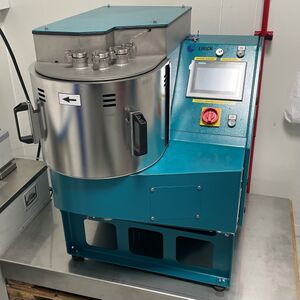
an image of a pilot-scale battery electrode slurry mixer

- Planetary Mixers: Ideal for small-scale or laboratory use, providing thorough mixing with minimal shear.
- High-shear Mixers: Suitable for large-scale production, offering efficient particle dispersion and homogenization.
- Ball Mills: Used for breaking down agglomerates and achieving fine particle distribution.
Dispersers
- Ultrasonic Dispersers: Utilize ultrasonic waves to break up particle agglomerates.
- Bead Mills: Employ grinding beads to achieve fine dispersion of particles.
Process Parameters
- Temperature: Maintain a controlled temperature (typically 25-40°C) to ensure binder solubility and prevent solvent evaporation.
- Mixing Speed: Optimize mixing speed based on the slurry viscosity and desired particle size distribution. High speeds enhance dispersion but may cause excessive heating.
- Mixing Time: Ensure adequate mixing time to achieve homogeneity without over-mixing, which can cause degradation of materials.
Quality Control
Viscosity Measurement
- Regularly measure slurry viscosity using viscometers to ensure consistency. Target viscosity varies depending on the electrode type but is generally within the range of 500-5000 cP.
Particle Size Analysis
- A grindometer is used to assess the particle size distribution in a battery slurry, which is critical for ensuring uniformity and optimal performance. By measuring how finely the active materials and conductive agents are dispersed, the grindometer helps in determining the slurry’s consistency, which directly impacts the battery's electrochemical properties and cycle life.
Homogeneity Testing
- Test slurry samples for homogeneity using techniques such as scanning electron microscopy (SEM) or energy-dispersive X-ray spectroscopy (EDS).
Safety Considerations
- Personal Protective Equipment (PPE): Wear appropriate PPE, including gloves, goggles, and respirators, to protect against hazardous chemicals.
- Ventilation: Ensure proper ventilation in the mixing area to prevent solvent vapor accumulation.
- Spill Containment: Implement spill containment measures to handle accidental spills safely.
Troubleshooting
Agglomeration
- Cause: Insufficient mixing or inadequate dispersing agent.
- Solution: Increase mixing time or speed, or add more dispersing agent.
Viscosity Fluctuations
- Cause: Inconsistent binder or solvent addition.
- Solution: Ensure precise and controlled addition of components.
Poor Adhesion
- Cause: Incomplete binder dissolution or inadequate mixing.
- Solution: Extend mixing time and ensure thorough binder integration.
Proper slurry mixing is essential for high-performance battery electrodes. By following these guidelines and continuously monitoring process parameters, manufacturers can achieve consistent and reliable slurry formulations.
- ↑ Ayerbe, et al. Adv. Energy Mater. 2022, 12, 2102696. DOI: 10.1002/aenm.202102696
jsondata
| type |
| |||||||||||
|---|---|---|---|---|---|---|---|---|---|---|---|---|
| subclass_of |
| |||||||||||
| uuid | "a6c6b673-d314-531e-83bc-e1010db7a848" | |||||||||||
| label |
| |||||||||||
| description |
| |||||||||||
| rdf_type |
| |||||||||||
| kit_step_id | "03" | |||||||||||
| kit_id | "03-Mixing" | |||||||||||
| successors |
| |||||||||||
| outputs |
| |||||||||||
| parameters |
| |||||||||||
| depends_on |
| |||||||||||
| attachments |
| |||||||||||
| name | "Mixing" |
jsonschema
| @context |
| |||||
|---|---|---|---|---|---|---|
| allOf |
| |||||
| type | "object" | |||||
| uuid | "a6c6b673-d314-531e-83bc-e1010db7a848" | |||||
| title | "Mixing" | |||||
| title* |
| |||||
| description | "mixing of slurry constituent components together with a solvent to create an electrode slurry" | |||||
| description* |
| |||||
| required |
| |||||
| properties |
|
This category currently contains no pages or media.